Sept. 1, 2006
Archbishop Wuerl Speaks About CUA and the Catholic
|
|
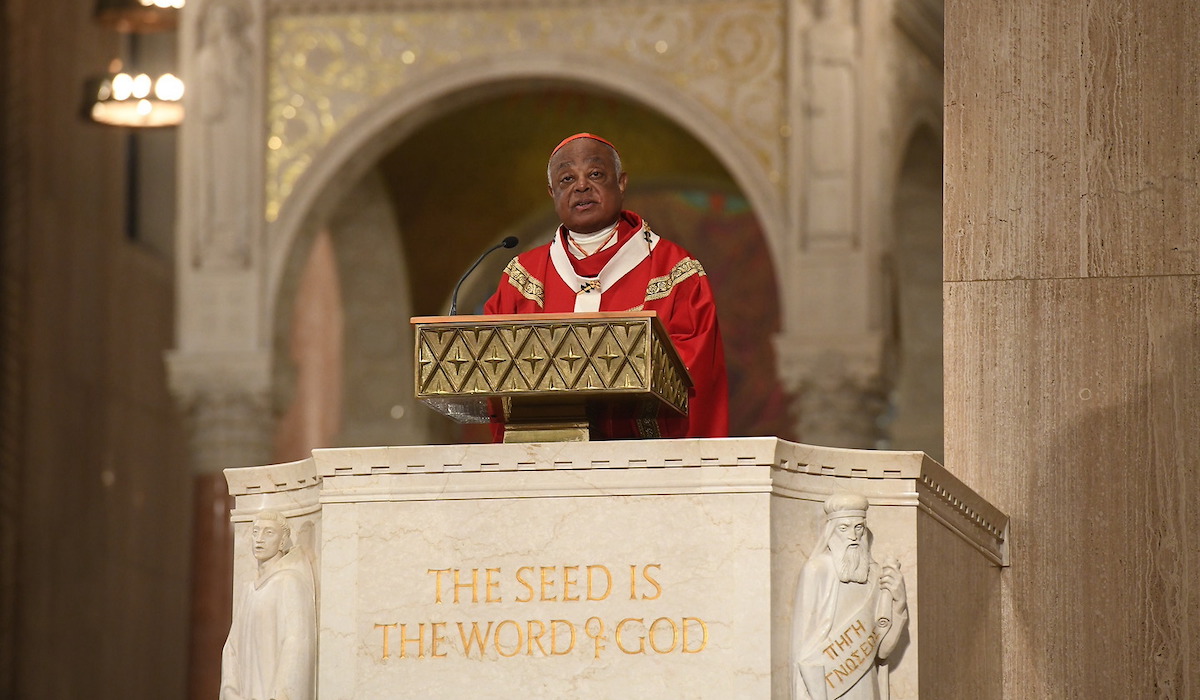
Hundreds of Catholic University students, faculty and staffed jammed
into a standing-room-only Crypt Church in the Basilica of the National Shrine
of the Immaculate Conception on Thursday, Aug. 31, to celebrate the
university’s opening Mass of the academic year and to hear Catholic
University’s new chancellor preach.
During his homily, Archbishop Donald Wuerl, a
CUA alumnus who recently was named to a university professorship, noted that
those who study and work at
“A Catholic university, this
university, offers you a vision of belonging to something much larger than just
yourself,” he said. “It is not as isolated individuals that we make our way
through life but as members of a community — your first experience of this is
as a member of a family.
“Just as we are nurtured and grow
within the confines of our natural family, so do we develop and mature within
the embrace of our spiritual family, the Church.
“This university opens its doors
and arms to everyone. No student who enters this campus is asked to leave his
or her faith at the entrance. But as an institution, the university invites all
to recognize that the values which guide this university, and life on its
campus, are manifestations of the faith of a larger spiritual family — the
Church.”
For the complete text of his homily, see below.
At the conclusion of the Mass, Archbishop Wuerl
offered remarks specifically addressed to
Father O’Connell said that he was gratified by the impressive turnout.
“There are few moments during the academic year at The Catholic University of
America that make me feel as proud to lead this institution as that moment
during the opening Mass of the Holy Spirit when the faculty and whole community
stand together to recite the profession of faith.”
|
|
Following the Mass, the entire CUA community was invited to a picnic on
the
Note: Additional photos of the Mass and picnic will be posted later this
afternoon on http://galleries.cua.edu/.
Homily by Archbishop Donald
W. Wuerl, S.T.D.
Archbishop of
But there is also more. We need to know as well what to do with all of
our scientific and technological information. We need to make judgments about
how we use what we know. There is a great distinction between knowledge,
information, the accumulation of data and wisdom.
The opening of this academic year brings us to this Shrine so that we
can open our hearts in prayer for the blessings of the Spirit, including the
gifts of wisdom, understanding and right judgment.
But we also do more. We come here to recognize that this university
brings us into a heightened awareness of what faith contributes to the great
human enterprise of examining and judging the human condition.
Every year
What distinguishes a Catholic
university or college from any other institution of higher learning is the
faith context that provides its identity. Each of us gathered for this
celebration of the Eucharist identifies ourselves in part by our belief in God
and our faith in Christ.
How shall I live?
What is the purpose of life?
What are the values that should
direct my steps through life?
Even those who do not share our
faith come to this university because they know that at its heart there is the
acceptance of values motivated by our faith — values
that present a specific vision or view of human life.
As you approach this academic
year, whether it is your first, last or intervening year on campus, you take an
additional step in the formation of your character and the refining of your
vision of life. In short, you will mold your outlook in a way that will direct
you well into the future.
Another dimension to the
Judeo-Christian tradition, of which this university is a living expression, is
the realization that we do not face life, the human condition and our response
to it alone. It is precisely as a community that the Church receives God’s
word, deepens its understanding in that revelation and applies that gift to the
circumstances of our day.
A Catholic university, this
university, offers you a vision of belonging to something much larger than just
yourself. It is not as isolated individuals that we make our way through life
but as members of a community — your first experience of this is as a member of
a family.
Just as we are nurtured and grow
within the confines of our natural family, so do we develop and mature within
the embrace of our spiritual family, the Church.
This university opens its doors
and arms to everyone. No student who enters this campus is asked to leave his
or her faith at the entrance. But as an institution, the university invites all
to recognize that the values which guide this university, and life on its
campus, are manifestations of the faith of a larger spiritual family — the
Church.
This academic learning community,
of which you are now a part, is an expression of that communion or community of
faith and spiritual conviction.
We should not be surprised if life
on this campus is different than what we would experience on some other
university and college campuses. By definition, The Catholic University of
America family is committed to the exploration of human intellectual
advancement precisely out of a lived tradition rooted in the word of God — the
wisdom of God. Thus as a university family, we are committed to values and the
recognition of the place of virtue in our lives as we develop and face the
challenge of personal individual choices and decisions.
By its very definition, the Church
will always be countercultural. The beginnings of the
|
|
At the same time, we are invited
into one of the great, if not greatest, human adventures — the changing of the
world into a better place that is truly reflective of what the Scriptures call
the kingdom of God — a realm of justice, peace, truth, compassion and
love.
The Church and her educational
institutions have the task of transforming human culture and bringing to
fulfillment all of the created goodness that seeks fullness in Christ. The
transformation of the temporal order will always be the mission of the Church
and its manifold institutional expressions.
Two thousand years ago, God sent
his own son among us. Jesus became one of us so that he could share our human
experience and, at the same time, reveal to us the
meaning of life, the importance of the choices we make, and the purpose and
goal of our existence. Jesus is the answer to the questions most deep within
our heart. How shall I live? What is the purpose of life? What gives meaning to
the things I do? What is the goal of my existence? What does God ask of me?
The prayer today and the Gospel
reading remind us of the place and power of God’s Spirit in our lives. Your
faith is an identifying characteristic of yourself, your experience, your
life. Never hesitate to recognize the
importance of God’s word, God’s wisdom and your relationship to God as you make
your way through life and through these great formative years.
It is my joy to celebrate with the
whole
We pray to the Holy Spirit for the
wisdom, understanding, courage, counsel and knowledge to appropriate the
revelation of Jesus that he is the way and the truth and the life. We ask the
Holy Spirit to enlighten us and strengthen us as we grapple with all of the values,
or lack of values, that are a part of our culture as we come to integrate into
our own view of life the timeless intuition “that it is not by bread alone that
we live.”
May God bless you and all who
support this university to help make the Church’s vision of life and your
dreams for the future come true.
—30—
#018
Any
questions or comments? cua-public-affairs@cua.edu
![]()
Revised: 9/1/2006
All contents copyright © 2006.
The
Office of Public Affairs.